
Ultimate Chess Guide: From Legal Moves to Real Plans
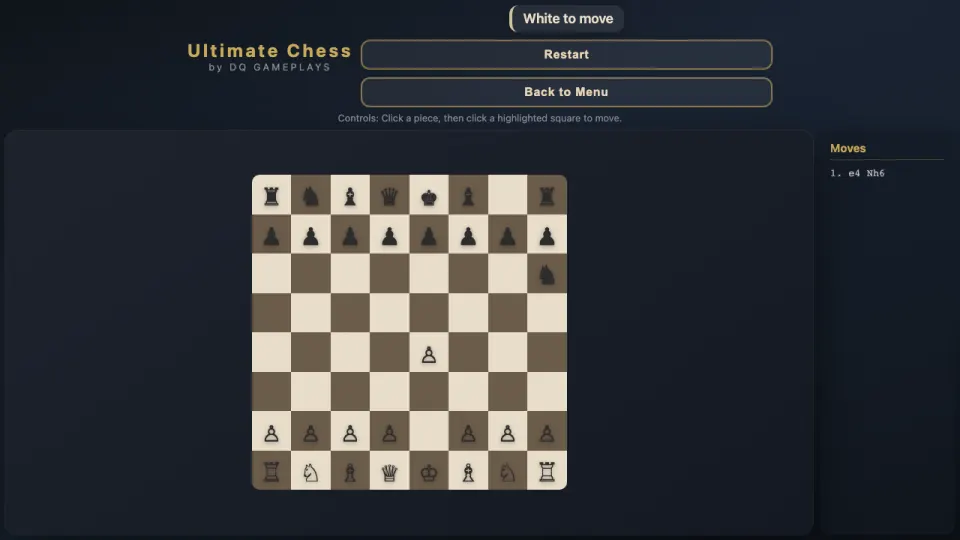 Click to play — free via gamemonetize
 Fight for the four center squares in the opening, castle within your first ten moves, and make every move develop a piece or answer a threat. When you are ahead in material, trade pieces — not pawns. Against the computer, replay one opening until you lose differently, because that is what learning an opening feels like.
Ultimate Chess is exactly what the title promises: the full, unmodified rules of chess in a browser tab, playable by two people on one screen or solo against a machine with three gear levels. Nothing is simplified and nothing is gamified, which makes it a rare thing — a chess program that respects the fifteen hundred years of theory it inherited.
For newcomers, this guide doubles as a first strategy course built around the interface's helpful quirks. For returning players, it is a tune-up: the opening habits, trading rules and AI-beating plans that turn 'knows the moves' into 'wins games'. Either way, everything here works identically whether your opponent is a friend on the same screen or the computer.
Let the highlights teach you the rules
The interface quietly removes the steepest part of learning chess: legal moves. Click any piece and its destinations light up in green, with captures marked in red, so the question 'can this piece go there?' is answered before you ask it. Beginners should exploit this shamelessly for the first few games — select every piece on the board each turn and simply look. Within a handful of games the movement patterns burn in: bishops stay on their color, knights hop in that L you eventually stop seeing, pawns capture diagonally, which still surprises everyone once. The restart and menu buttons make consequence-free experimentation cheap, so use them. Nobody learns chess by reading about it; everybody learns it by moving pieces and watching what the board allows, and this board explains itself generously.
The center is the whole board's rent
Every opening principle compresses into one sentence: the player who controls the four central squares decides where the game can be played. Pieces in the center reach more squares, see more threats, and can redeploy to either wing quickly; pieces on the rim commute without contributing. So spend the opening doing center work: a pawn or two into the middle, knights developed toward central squares, bishops placed where they cut across the center's diagonals. Resist the beginner's instinct to attack with wing pawns early — those moves spend time on territory that decides nothing while your opponent quietly builds in the middle. Most games between beginners are decided by nothing more mysterious than who occupied the center and who watched from the suburbs.
Castle early and sleep better
The king is both the game's victory condition and its most clumsy resident, and castling is the one move that solves the problem in a single turn: king tucked into a corner, rook developed into the game, two birds with one special move. The working benchmark is to castle inside your first ten moves; a king lingering in the center collects checks, forks and lost tempi like souvenirs. Two cautions keep the move safe. First, clear the pieces off the castling squares before you need the escape route — castling requires the path empty and neither piece moved, so develop whatever sits between king and rook promptly. Second, glance at the pawn shield after castling: the structure protects the king only while those pawns stay healthy, so think twice before pushing them forward for space you do not need.
Every move should carry two purposes
Strong players waste nothing, and the discipline that separates them from beginners is dual-purpose moving: each turn develops a piece and creates a threat, or improves a position while answering an opponent's idea. The beginner pattern is single-purpose play — shuffle one piece repeatedly, chase an early attack, respond to threats with retreats that develop nothing. The correction starts with a question asked before every move: what does this do besides what I want right now? Develop knights toward the center rather than the rim, bring bishops out where they pressure something, and avoid moving the same piece twice in the opening while its teammates still sit on the back rank. If you cannot find a move with two purposes, make the most useful one-purpose move available and keep the plan simple.
Trading: the quiet art of winning
Captures are decisions, not reflexes, and the trade is chess's most misused tool. The core rule is material-relative: when you are ahead in material, trade pieces aggressively — every swap simplifies the position, and a small army advantage grows as the board empties. When you are behind, hoard pieces and complicate; equalizing trades only polish your opponent's lead. Pawns follow the opposite logic, because they cannot run: invite trades of your opponent's pawns when it opens lines for your pieces, but keep your own pawn structure intact as the skeleton of your endgame. Beginners err in both directions — refusing advantageous swaps out of attachment, or snapping every capture offered without asking who benefits after the dust settles. Before any capture, count what remains: the player who wins the final quiet board, not the exchange itself, wins the game.
Beating the machine at three gears
The computer offers easy, medium and hard, and each level teaches something different. The easy setting is for pattern practice — punish its loose play, drill your checkmates, and build confidence in finishing won positions, which is genuinely a skill. Medium punishes slow development and rewards the opening principles above; if you lose here, the answer is almost always center control and castling discipline rather than tactics. Hard is the real teacher: it locates the intent behind your moves whether you brought one or not, and it never donates material back. The proven way to climb is repetition with variation — play the same opening against it several times in a row, losing differently each time, until you understand which of your habits the machine is punishing. Changing openings after every loss resets that education to zero.
Two players, one screen, one mouse
Player-versus-player mode runs the full game on a shared display, turns alternating through a single mouse, and it revives the oldest form of chess education: a regular opponent who knows your habits. Structure helps these games improve both players. Play complete games rather than endless blitzer rematches — finished endgames teach more than repeated opening traps. Agree on a simple clock substitute, like finishing each move within ten seconds or paying a friendly penalty, because hour-long turns drain the fun from both chairs. And adopt the post-game ritual that strong pairs use: replay the one decisive mistake together, each arguing their side of it. The argument is the lesson. Two players who review one mistake per game improve faster than two hundred players who only play.
FAQ
Can two people play on one device?
How strong is the AI?
Does the game show legal moves?
Related guides
 1P/2P
1P/2P